
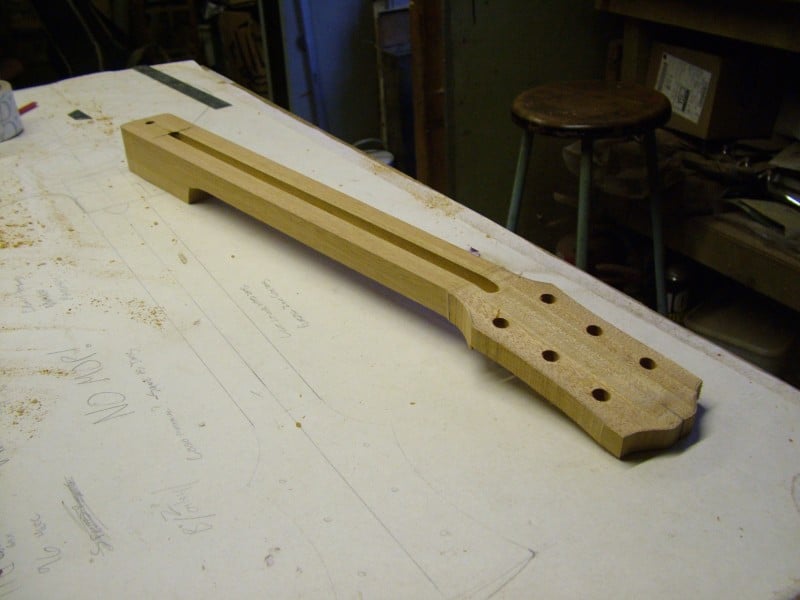
….Working on the neck
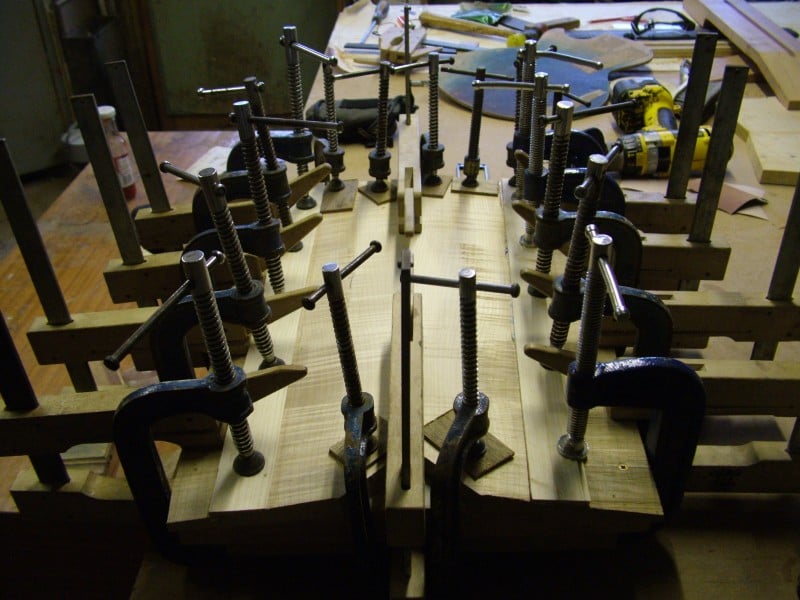
After gluing the cap on I went back to working on the neck.
Cutting out the neck is a two stage process – I sometimes call it ‘Profiling’ some people call it copy routing……Profile – just means shape….necks have a side profile which I cut out last time, and a front profile (what it looks like from the front) which I cut out today…….
- Cut it out roughly on the bandsaw
- Route the profile
1. This does not need to be accurate as the router will take care of that in the next step.
2.The neck profile is routed by attaching a pattern and copying the shape into the neck with a profiling cutter. This is done in layers so there is less stress on the cutter and the router than trying to take it all off at once. When the router ‘bottoms out’ or cannot go any deeper, take the pattern off and you can get a few more passes. The final 1/2″ or so is done by turning the neck over and trimming the excess with a bottom bearing profiling router cutter.
note: I have cut out the headstock on the bandsaw but not routed it – if I was making a lot of guitars with the same headstock I would make a pattern with that headstock shape. I am using a B1 pattern here but just skipping the headstock which will be finished by hand instead.
Got it? Good…..
If you can do this you could make anything – all you need is a bandsaw and a router!
I make the pattern out of scrap – if it goes wrong, chuck it away and start again…if it goes right copy it with the router and keep it as a master.
Next I did the back of the headstock
The headstock thickness jig is just a board with two lumps of wood glued to it (guide rails) which the base of the router sits on to do its job. I made a larger base for my router which screws on, allowing me to span a wider gap for larger headstocks.
The headstock is stuck face down on the board between the two ‘guide rails’ so the router can take off layers. This leaves it very flat and accurately cut to thickness easily adjustable with the depth stop on the router. I always cut around the edge first – it helps to avoid breakout. I want it to measure about 15-15.5 mm when finished – it will have a 1mm ebony veneer – so I took it down to 14.5mm.
I only route enough for the tuners to sit flat, or you could end up going into the neck. This leaves a step which will be carved off by hand later.
Drilling the tuner holes
I used the double sided tape again to stick on the headstock pattern so I could use it for a drill guide to make the tuner holes.
The last thing I did today on this guitar was to put the truss rod in. The slot for the truss rod is routed about 1mm deeper than the truss rod, so that a fillet can be glued in on top. This will act as a spacer to take up any slack, and prevent any truss rod vibrations and noise.
Hope you are enjoying the pics…….[email_link]
0 Comments